

The bones in each of your feet make up a quarter of all the bones in your body so it’s no surprise that these are very important foundations for the rest of it!
The feet contain 26 bones in total, of which there are three groups: the tarsal bones, metatarsal bones, and phalanges, 30 joints, more than 100 muscles, tendons and ligaments, all of which work together to provide support, balance and mobility.
These are highly developed, biomechanically complex structures that not only bear the weight of the body but also the forces many times the weight of the human body during activity, movement and exercise.
Read on to find out how to look after, stretch, strengthen and mobilise these important, strong and complex mechanical structures.

Foot exercises for healthy feet
Whether you do intensive high impact exercise and what to optimise your performance, help relieve discomfort or would just like to look after your feet to avoid pain and injury; feet exercises can help. They’re simple, don’t require special equipment and can be done as part of your exercise routine at home.
Our first tip – walking! It’s the best overall foot exercise. Walking puts your foot through its full range of motion, from when the heel hits the ground until the toes lift off. If you’d like to try some other specific foot exercises then here are our top five to help promote overall healthy feet.

Balance on one foot
This is a great one to practice throughout the day, when you’re waiting for the kettle to boil or even when watching the television!
We recommend you have something to hold onto when you first try this one such as a kitchen bench or chair. Holding on, lift one foot up and balance on the other. Hold for a few seconds, and gradually build up how long you can do this for until you get to about a minute. Repeat it three times on each foot as often as you can.
Then, as you improve try adding these variations:
- stand on something that challenges your stability such as a cushion or pillow. You might need to start holding onto something again and, as before, build up the time you hold it for.
- do the standing on the floor version but try it with your eyes closed.

Toe extension
Sitting in a chair, lift one foot up and cross it over the opposite thigh. Gently pull your toes up towards the front of your ankle with your hand until you feel a nice stretch along the bottom of your foot. Hold it for about 10 seconds. You can also use the other hand to massage the arch of your foot at the same time to relieve any tension in the plantar fascia and muscles under your foot. Try repeating this a few times on each foot, a couple of times a week.
Foot and heel raise
Stay in the chair for this one too with your feet flat on the floor. Raise and lower your heels and then toes off the floor in a single repetition. Hold it for two seconds and lower back down. Repeat 5 – 10 times a few times a week. This is a great one to do whilst you’re sitting at your desk working. We want to progress this exercise to a standing calf raise eventually and ultimately a single leg raise.
Ball roll
This is one of our personal favourites. Start sitting down again for this one. Place a ball – (tennis, golf, spiky exercise or another small ball) – on the floor next to you. Try a few different ones to see which you prefer and adjust the pressure you apply too, to find out what works best for you. One foot at a time, put it on top of the ball and press down before moving the ball around to massage the bottom of the foot. Two to three minutes on each foot is about right.
A variation on this one is to find an object that you can roll back and forwards under your foot (such as a tin can). Place it under your foot (one at a time) and roll your foot back and forwards on the tin for a few minutes.
Calf stretch
This one is also a good plantar fascia stretch and you do it standing up. Face a wall and put both hands flat on the wall at about shoulder height or slightly higher. Move one foot back about 30cms (or however far you can whilst keeping both heels flat against the floor). Keep that leg straight and put a bend in the front knee. You should feel an ‘Ahhhhhh’ stretch in the calf muscles in the back, straight leg. Relax before repeating 3 – 5 times on each leg. Also do this with the back leg bent to stretch a different part of your calf muscle.

Foot exercises for strong feet
Keeping your feet strong can help prevent injury and reduce pain and soreness by increasing the control over the muscles and joints in the toes and feet so that they are better able to support its structures.
The most fun and easy exercise to do (we think) is simply walking barefoot in sand. If you need an excuse to get to the beach this summer, then this is it! Sand walking both stretches and strengthens the feet and calves.

Toe splay/spread
Back in the chair again, spread your toes apart from each other as much as you can comfortably. Hold, repeat 5 – 10 times (or until your feet start feeling tired) and then switch feet. To advance this you can add a rubber band across the toes from the big to the little toe to add resistance!
Tip – keep the toes straight and focus on trying to get the big toe as far away from the little toe as possible.
Towel pickup
This time, have a towel on the floor in front of you, under your feet whilst you sit in the chair. Keep your heels on the ground as you, on foot at a time, scrunch up your toes to pick up the towel. Now you’re not lifting it off the floor. Just grab it between your toes, hold for 2 – 3 seconds and release. Do this five times on one foot and then repeat on the other foot.
As you get really good at doing this, you can add a weighted object to the far end of the towel. You’ll thank us later!
Foot exercises for flexible feet
To improve flexibility, mobility and range of motion, try these gentle stretches and mobilisations.
Toe raise, point, and curl
You should do the next three sitting down. Start with your feet flat on the floor and then, keeping just your toes on the ground, raise your heels stopping when just the balls of your feet and toes remain on the floor. After five seconds, lower your heels back down. Once you’re comfortable with this one, raise the heels but this time, keep going until only the tips of the big and second toes are touching the floor. Hold for five seconds if you can and then lower all the way back down.
Big toe stretch
Cross one foot over the opposite knee. Use your hand to gently stretch the big toe up, down, and to the side. Keep the big toe in each position for 5 seconds. Repeat 10 times and then do the same on the other foot.
You can get all the toes involved in this one too if it feels good. Take hold of the base of your toes with your hand gently and pull them back towards your body, until you feel a soothing stretch. Hold for 15-20 seconds
Ankle rotations
Again, cross one leg over the opposite thigh or, if you find it more comfortable, simply raise one leg slightly off the floor whilst keeping it straight. Bend your ankle up towards your body as far as is comfortable, and then start to rotate round in a circular motion until you’ve done a full 360. Keep going in circles five times and then reverse the direction. Then, yep, you’ve guessed it – repeat on the other side!
Calf strengthening
Stand up for this one with feet shoulder-width apart. It’s best if you can be on the bottom step of a staircase. And feel free to hang on to something for balance. Stand with the balls of your feet on the step and your heels off the back, in bare feet. Let your heels slowly drop below the level of the stair. Come back up and add a heel raise. The balls of your feet should never leave the step. Do 5 – 10 adding more as you practice.
If you don’t have stairs at home then you can use a towel or exercise band around the bottom of the feet whilst you’re sitting on the floor with your legs outstretched. Then modify the heel raise by using a chair for support, and stand, raising up on your tiptoes (keep your legs straight). Slowly lower your feet back down. Repeat this 10 times.
What should you do next?
Regularly exercising and stretching the feet and ankles can help the muscles to provide the best support for your body. Start any new exercises slowly and gently, and build up. Stop any of the exercises if they make your symptoms worse, or cause new pain and contact a Podiatrist for advice.
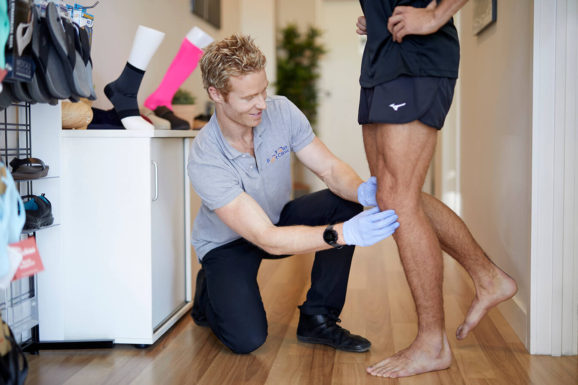
If you’re experiencing pain or would like some advice about how to strengthen your feet, then book an appointment at your nearest clinic. At Your Foot Clinic, our Podiatrists provide a thorough analysis of your feet, footwear, lifestyle and needs in order to tailor a treatment plan to suit you.